How Do You Know if Your Window Crack Is From an Earthquake
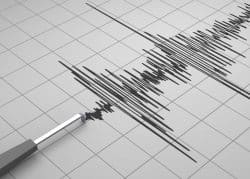
After an earthquake our attention is often directed to cleaning up fallen objects, rehanging pictures and putting everything back in place. Seldom do nosotros call back about checking for structural harm, unless information technology's so obvious that we only tin can't miss it.
Since the forces of an earthquake are so powerful, knowing how to tell if your home is safety later on an earthquake and knowing what to bank check, is fundamental in keeping you rubber: for moderate and severe quakes can crusade serious structural damage and injury.
A quick structural check is like a pilot walk effectually
Just as an airline pilot always does a walk effectually of his plane prior to a flying, you should practise a structural walk effectually afterwards an earthquake.
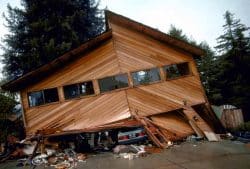
What makes a quick structural check so of import?
The house may have suffered more harm than you idea, just since you lot were and then busy straighten upwardly, you didn't put much effort into looking for less obvious signs of structural damage.
What many people don't often recollect well-nigh is that the earthquake may have loosened or damaged key components of the structure merely plenty that the firm didn't fall or collapse, just that with just a little bit more shaking, it may suffer meaning damage since it had already been weakened quite a bit. Y'all could say that you might exist merely ane jolt abroad from a collapse or structural failure.
What types of homes are more at risk?
The risk of harm and the severity of harm to a home depends on a number of factors and categories, including the magnitude of the earthquake, the closeness to the epicenter, and the age and type of structure. Should an earthquake occur, be sure to cheque your home for structural harm or weakness right after the convulsion, as well as subsequently any aftershocks.
Split level, "T" and "L" shaped homes are college adventure
Homes that are "T" shaped or "L" shaped are likely to incur more damage than ones that are square or rectangular in shape; ones that are irregular in design or divide-level homes likewise do non fare besides. These types of homes are more vulnerable to torsion or twisting near their longitudinal axes because they practice not distribute seismic forces equally or as well as square or rectangular types of homes.
Homes with brick, cake or stone

There are non many homes existence congenital today structurally out of masonry block, brick or rock. Those that were congenital many years ago do non concord up well in moderate to severe earthquakes. In many cities in the U.S. older solid brick buildings are being required to be seismically improved and retrofitted, especially public buildings and schools.
Houses with brick or rock veneer on top of a wood frame diaphragm may have some of the brick or stone veneer fissure or fall off, but the dwelling house may still remain structurally safe.
Older homes
Edifice codes did piffling to address seismic issues for many years and because of this many older homes do not perform well in earthquakes. In 1973 the Uniform Building Lawmaking started to require the walls of a house to be anchored to the foundation, still, the code requirements were minimal and compared to codes today, they were non nearly as effective. In addition to requiring the walls of the home to be connected to the foundation, they upped the requirements of bracing cripple walls.
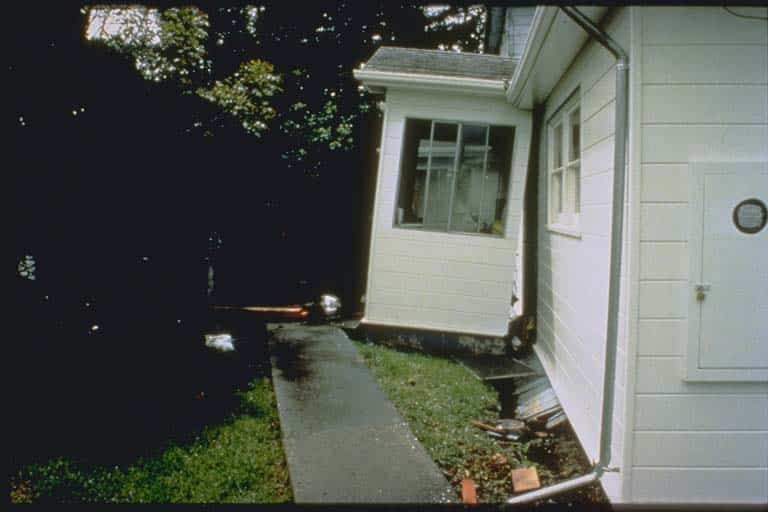

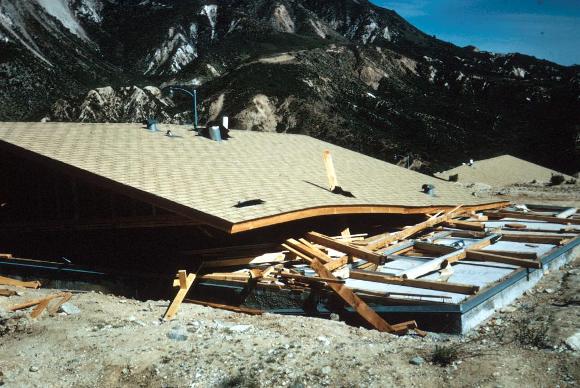
FEMA hazard cess of how a home may perform in an earthquake is broken down into various categories, one of which is historic period. When it comes to the age of the home, they have four historic period brackets with each given a certain bespeak score.
The dwelling house was built:
- earlier 1920 [deduct 3 points]
- 1921 to 1977 [deduct ii points]
- 1978 to 1993 [deduct 1 ]
- 1994 or later – [ no points deducted ]
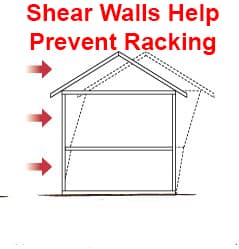
Shear walls
Lateral forces in an earthquake can cause tremendous damage to a abode but the damage can be significantly reduced by the utilize of shear walls.
These shear walls are engineered to add together forcefulness and stiffness to a home which significantly reduces lateral movement of a home during an earthquake, thus reducing damage to the structure. In woods framed homes you will often see much of the exterior walls covered with iv×8 sheets of plywood or OSB board (oriented strandboard).
Older homes generally do non take engineered shear walls in them. Homes built later 1998 will usually take shear walls and since so the seismic requirements take even get more stringent.
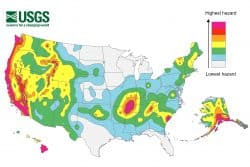
Risk based on where you live in the U.s.a..
Chance of earthquakes varies depending in which part of the The states that y'all alive. Insurance companies utilise your geographic location as one of the premium setting metrics when they price Earthquake Insurance.
To learn more than about the risk level in your specific location you lot tin can check with a number of country and federal entities that accept maps and other data on the take a chance in your locality. Ane of the all-time sources for this information may be your local edifice section.
Note that the building code requirements may vary from state to state and customs to community.
Hillside homes
Hillsides can be susceptible to landslides triggered by earthquakes and when this occurs, homes on these hillsides generally suffer more damage than others, especially if the hillside has water saturated soil.
If you live in a hillside home, exist sure to check the that its walls are fully secured to the foundation and that in that location is no damage where the wall is secured to the foundation; if the domicile sits on post, caissons or piers, be sure the posts or piers are non damaged or tilted and that the connection points are sound and not damaged.
If the homes foundation is not flat or stair stepped but sloped similar to that of the hillside, and then be extra vigilant of the connection of the home to the sloped foundation, for these connections are more decumbent to failure.
Geotechnical issues
If a domicile is synthetic on unstable soil, poor load begetting soils, soils that are prone to gradient pitter-patter or landslides, or areas where in that location may exist liquification issues or a high-water table; be cautious, for these homes tend to suffer more damage than ones built on stable soils or bedrock.
The reason for this is that if the foundation shifts or becomes damaged due to poor or shifting soil, and then everything that sits on the foundation generally suffers more damage than normal.
What To Check Structurally On The Outside & Interior Of The Habitation
Exterior
The homes' connexion to the foundation
One of the first things to check is the homes' connection to the foundation. This is critical, for if a dwelling has shifted on the foundation, it is usually considered an of import issue and could even be more serious than what you might call up, for once the connection of the business firm to foundation is weak or broken, some other afterwards shock may crusade the firm, or portion of information technology, to collapse or fall off of the foundation.
This may consequence in injuries or fires. If you discover the house has shifted or is partially off the foundation, you may not desire to stay in the house until a professional person has determine the seriousness and gamble. If there are aftershocks occurring, y'all desire exercise even a higher-level of caution.
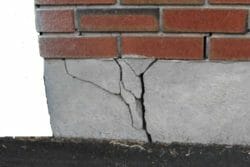
The Foundation
Check for:
- Cracks
- Is the foundation leaning or tilted?
- Does it bow?
- Levelness of foundation
Over the years it is not unusual for foundations to develop a few cracks, many owing to settling and expansive soils. When earthquakes occur, information technology is not unusual for cracks to develop or existing cracks to widen. When there are foundation cracks, there are many factors that relate to how serious the cracks are; i.due east., "V" shaped cracks and offset cracks are by and large considered a bigger business concern than modest hair line blazon cracks. If a quake creates a crack that is a ½ inch or an inch wide, it would definitely exist of concern; if only a hairline cleft or an 1/8 of an inch, then it would normally not be as much of a concern.
Foundations that are leaning, bowed or out of level are likewise a concern. Naturally, the more than movement of a foundation, the more the level of business concern. If you're not sure if the foundation is level and plumb, you can use a level to tell if it is leaning or use a long string line to come across if it'southward bowed.
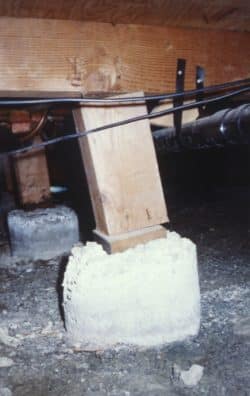
Crawl spaces
If your habitation has a crawl space under it and it has a pier and axle construction, sometimes called post and axle; and then these should be checked, for it is not uncommon for the mail service or beams to shift out of position or crack. Should this happen the floor may sag or slope and if enough seismic damage has occurred it may collapse.
Check the connectedness area of all the post and beams, as well every bit, the post connections to the piers of post pads (footings).
Do not enter any crawl spaces alone or if there is any noticeable damage to the business firm. You tin can do a cursory await from the crawl space admission but do not put yourself in danger or an area where you tin can go trapped or injured if a tremor, aftershock or convulsion should occur.
Basements
- Any bowed or cracked basement walls?
- Do any walls lean inwardly or lean outwardly?
- If the basement has posts or beams; take whatever of them croaky or shifted? Do any of the beams sag or whatsoever of the postal service lean?
- Remember to look at the connections where the post and beams come up together and at the post bottoms to come across if they are even so continued properly to the flooring.
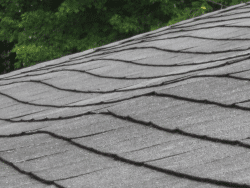
Roof
Stand dorsum from the house, where you lot can see the roof and look for changes or damage. Await at information technology from all sides.
- Await at the ridge line of the roof; is information technology straight?
- Does the roof sag or bow in places?
- Is the roof wavy?
- Are there any humps that weren't visible earlier?
Check for damaged to the rafters and trusses, every bit well as the remainder of the roofs framing. Occasionally, in an earthquake, if the ridgeline is bowed, it's because the walls are leaning outward at the top of the exterior walls on opposite sides.
Remember, if there is still seismic activeness or after shock warnings, do not enter the attic areas where y'all may get trapped or injured if at that place was another earthquake or a roof failure.
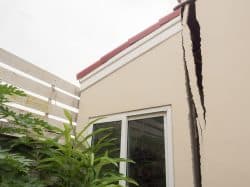
Exterior walls
Stand at each corner of the house and visually site downwards the wall to run into if there is anything unusual.
Are there any bowed, wavy or damaged outside walls?
If not certain, pull a string line downward the length of the wall to see if it is straight. Utilize a level to see if information technology is leaning or tilted.
Should the wall accept problems, you should examine closely the connection of the wall to the foundation. Likewise, the roof framing connection to the wall should be examined.
If reverse exterior walls lean outwardly, you may want to double cheque if the roof is sagging and bank check the collar ties and rafter ties in the attic to see if they have pulled loose or if they're damaged. Check the residuum of the roof and attic framing at the aforementioned time.
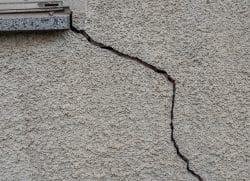
Stucco Cracks
Stucco walls. Has the stucco cracked or fallen off in places? It is not unusual to have some stucco cracks, especially at door and window corners, a crack that is iii/8 inch or an inch wide would exist a "Yellow" or "Red" flag.
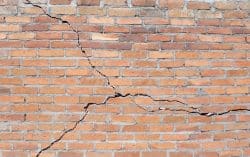
Brick and Stone Walls
When you hear the words "it's a brick firm" be careful, for there are basically 2 types of brick houses. One, is where there are ii or more layers of brick and the brick are structurally part of the house; if you removed the brick, the firm would fall downward.
The second type is where there is a brick veneer that is continued to a structural wall (i.e. a wood framed wall) and that if you removed the brick, the wall and house would remain standing.
In the old days many houses were built out of solid brick walls, the bricks were a structural component of the house, had a long-life span and held-up well to fires. The problem with these types of houses are that they practice not stand well in earthquakes. Seldom are solid brick homes congenital now days.
Nigh brick homes congenital today are the second blazon where the brick is held to the framing of the house, usually with some form of ties to connect the brick to the framing. You can remove the brick and the house still remains standing; the bricks are basically for protecting the framing and for architectural purposes. The same concept basically applies to rock houses.
Check for cracks in any brick walls
In solid brick or block walls, cracks are mostly considered more than serious, than cracks in a brick veneered wall; small hairline cracks in veneered walls are generally non of much concern. Cracks that are a quarter or one-half inch wide would exist a concern and if the wall is leaning or bowed, they become fifty-fifty more than serious.
Forest framed houses ofttimes perform better in an earthquake than masonry houses considering they are less rigid and they tend to flex, absorbing and disperse energy meliorate when exposed to sudden earthquake forces.
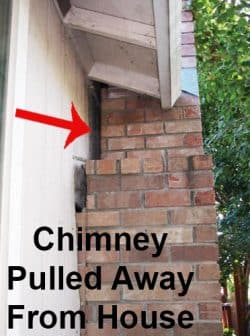
Fireplace
- Any damage or cracks in brick, block and stone chimney and fireplace?
- Has the chimney pulled loose from the firm wall?
- Is the chimney leaning, or bowed?
After an earthquake Boob tube stations and newspapers will often accept photos or film of a fireplace chimney that has collapsed on a car or onto the neighbour's house. These striking pictures catch your attending, but what they don't tell you is that at that place are many fireplaces that are all the same standing, only that they take cracking or impairment that is structural or that may be a burn hazard and that these fireplaces should exist carefully checked.
Be careful virtually using the fireplace for heat if the earthquake knocked the ability out, for cracks in the fireplace or damaged flues may actually crusade your house to take hold of fire. (Read virtually types of fireplace inspections that you can become)
Yard and Retaining Walls
If you come across evidence of soil movement in your 1000 or if in that location is a retaining wall that adult cracks, started to lean or fell over, then y'all may desire to think of it as a "Yellow or Red Flag" that your house may take suffered structural damage. If you have block walls or brick fences and they are leaning or damaged, that is boosted evidence that the house may have suffered damage.
Leaning and damaged retaining walls tin can exist a safety hazard if they're in danger of falling over. Besides, if a retaining wall is close or high and information technology moves enough, it may accept an event on the foundation of the house, which may result in structural damage.
Cracks running through your yard, the street or on an adjacent hillside should be considered a warning sign that the house may take possible foundation impairment.
Interior
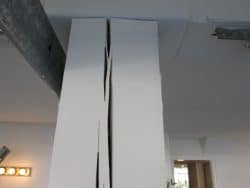
There may be various warning signs on the interior of the firm that the framing or foundation has suffered structural damage. Should y'all run into some of these alarm signs exist sure that you carry a structural check as outlined. Expect for the following.
- Doors that have gaps, that are stuck close, that rub or that are difficult to open and shut
- Windows that take gaps, that are stuck close or they're hard to open and shut
- Cracks in the drywall or plaster. Wide cracks, diagonal cracks and in corner areas (wall to wall and wall to ceiling) may indicate that the home has shifted and are of concern.
- Leaning or bowed walls
- Sagging or damaged ceilings
Sloped or sagging floors
During an earthquake the soil under a domicile and foundation shifts and moves. This soil move may have caused the foundation to crack, slope or shift.
As a result of foundation movement or damage, the floor may now slope; therefore, if the flooring is sloping and so other parts of the construction may also have moved or suffered impairment. If the flooring slopes a i/8 or 1/4 inch in ten or 15 anxiety, it may not be major, but a one or ii inch drop would be a structural concern.
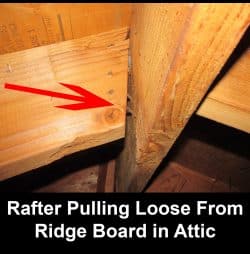
Attic
If the roof is sagging or bowed, or the interior ceilings are sagging or cracked, so you may want to wait in the attic. Bank check for broken or cracked trusses and rafters, likewise as, bent or loose hardware and nails that take pulled loose.
Has the rafters begun to separate from the ridge board?
If a house has had pregnant movement, the rafters may take pulled loose at the ridge lath or a ridge beam. If the exterior walls of the house are leaning or tilted, it is common for the rafters to pull loose from the ridge lath.
If the rafters are pulling loose and in that location is an aftershock or a bigger earthquake, then the roof may collapse because the first quake loosened things and then much that even a little jolt may bring it down.
Who to consult on structural issues?
When in doubt about how safety your business firm is after an earthquake, be on the safe side and consult a professional person.
- FEMA and other emergency disaster agencies personnel
- Local edifice section
- Structural engineer

Don't exist one wait away from an injury or a structural collapse. Do a quick structural cheque of your home.
Subsequently whatsoever moderate to significant shaking, do a preliminary structural check, for if there is harm, i.e the house has shifted on the foundation; then, if there is a stiff aftershock, the firm may partially collapse injuring the occupants. Therefore, if yous note structural damage correct after the first quake, you may decide not to stay in the home, for it may be weaker and may not safely withstand some other jolt, fifty-fifty a pocket-sized one.
Exist careful inbound your home if it'south damaged, even moderately damaged homes can be chancy at times.

In some of our articles we provide links to products that may be beneficial given the subject area matter of the content. Nosotros receive a small commission if you cull to purchase a product or service subsequently post-obit one of our chapter links merely the toll is the aforementioned for you.
mcmullenherat1941.blogspot.com
Source: https://buyersask.com/structural/earthquake/how-to-tell-if-your-house-is-safe-after-an-earthquake-what-to-check/

Post a Comment for "How Do You Know if Your Window Crack Is From an Earthquake"